|
Soil type |
# of rare species |
|
Serpentine |
285 |
|
Granite |
109 |
|
Clay |
94 |
|
Carbonite |
90 |
|
Volcanic |
88 |
|
Alkaline |
62 |
|
Gabbro |
20 |
|
Sandstone |
16 |
|
Shale |
10 |
|
Gypsum |
1 |
California houses more than 6,000 plant species. An impressive number when compared to New England, an area of similar land size, which houses fewer than 2,000 species. The only state which comes close to California’s flora diversity is Texas, around 5,000 species, which has a much larger land area than California. Of California’s 6,000 species, 1,742 are classified as rare.
In order to examine the diversity of plant life, both in Buck Knoll and in California, we must synthesize the many ways in which geology works to promote and distribute distinct vegetation communities through space and time, also known as biogeography. Most land has zonal soil where the soil’s physical and chemical properties reflect its environment, and they have optimal nutrients for plant growth. Azonal soils defy regional climate and reflect unusual properties of the parent material from which they weathered. The characteristics of serpentine soil, an azonal soil, will be derived from the serpentinite rocks that created it.
Azonal soils are where California gains many of its rare and endemic species as plants evolved to tolerate these unideal soils in the areas where they occur. As many outcrops of azonal soils are isolated from each other, they have ended up creating “narrow endemics”, plants that only occur one specific instance of a specific plant community. Out of all California’s rare plant species, 285 are found in serpentine soils, only Cuba and New Caledonia have greater serpentine region biodiversity.
But What is Serpentine?
In terms of geology, serpentine is a family of minerals within the mafic and ultramafic group where “ma” refers to magnesium and “fic” refers to iron (Fe). Ultramafic rocks contain more than 70% mafic minerals and come in two forms: igneous and metamorphic. Both these rock types contain iron-magnesium silicates and are devoid of feldspar minerals that contain calcium, sodium, and potassium silicates.
Ultramafics are associated with subduction zones wherein subduction exposes a sequence of rocks – ophiolite suites – where ultramafics are the lowermost strata, derived from the upper mantel. “Serpentine” and “ophiolite” both refer to ultramafic rocks and both refer to “snake” one in Latin and the other in Greek, possibly alluding to the snakeskin patterning and color of serpentine. Dioscorides, a Greek herbalist, claimed that pulverized serpentine rock could be taken as an antidote for snake bites.
Serpentine soils are produced from the weathering of ultramafic rocks, both igneous peridotites and dunites and the metamorphic serpentinite. The resulting soil is often a reddish-brown due to high concentrations of iron oxide with a texture ranging from gravelly loams with varying amounts of rock shards to fine-textured loams. Serpentine soils have high levels of magnesium and toxic heavy metals such as nickel, chromium, and cobalt. They are deficient in essential nutrients such as nitrogen, phosphorus, and potassium.
Serpentine soils create areas referred to just as “serpentine” where plant communities associated with serpentine soils and other ultramafic soils grow. These plants have adapted to tolerate the soil’s mineral imbalances and high heavy metal concentrations. Often, serpentine associated plants will require lower levels of essential nutrients, especially nitrogen and phosphorus. Some serpentine plants demonstrate nickel hyperaccumulation (Ni > 1,000ppm) which discourages some herbivorous insects, and other plants will exclude nickel from their root zones.
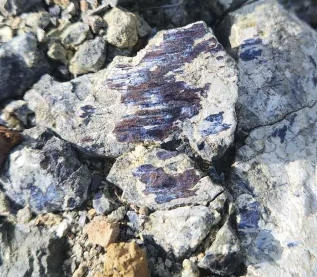
But What Makes Blue Rock Blue?
Blue Rock is home to stones called “blueschist” – a metavolcanic rock, a volcanic rock that have undergone metamorphosis, formed from basalt and other similar rocks at relatively low temperatures and very high pressures which are possible due to the subduction plate.
Igneous, mostly intrusive ultramafic rocks
- Dunite: contains more than 90% olivine
- Gabbro: medium to coarse grained w variable amounts of plagioclase, feldspar, pyroxene, and olivine
- Peridotite: group name for ultramafic rocks w variable amounts olivine and pyroxene; includes dunite, hartzburgite, and others
Minerals in Igneous Ultramafics
- Olivine: Mg2SiO4 also (Mg,Fe)2SiO4
- Pyroxene: various silicate minerals, e.g. diopside: CaMgSi2O6
Metamorphic Ultramafic rocks
- Serpentinite: ultramafic rocks containing serpentinite minerals
- Rodingite: altered gabbroic rock containing abundant calcium silicates; often at contact zones between serpentine and non-ultramafic rocks
Minerals in Metamorphic ultramafics
- Chrysotile: Mg3Si2O5(OH)4 (fibrous form is asbestos)
- Lizardite: same formula as chrysotile but platey in texture
- Antigorite: similar to chrysotile, occurring as corrugated plates or fibers
- Talc: Mg3Si4O10(OH)2
Sources Used to Write this Page:
Kruckeberg, Arther R. Introduction to Soils and Plants. University of California Press, 2006. https://www.ucpress.edu/books/introduction-to-california-soils-and-plants/paper
Dawson, Arthur. “What Makes Blue Rock in Cazadero Blue?” The Press Democrat, The Press Democrat, 23 Aug. 2022, www.pressdemocrat.com/2022/08/23/what-makes-blue-rock-in-cazadero-blue/.
Special thanks to the library for loaning the books. :)